Context Engineering: The Technical Foundation for AI-Powered Revenue Intelligence
Kang
AI Developer
January 23, 2026
11 min read
Introduction
In the previous post, we explored why traditional CRMs fail at committee selling. The data you need—stakeholder priorities, influence dynamics, engagement patterns—is either missing, buried in notes, or scattered across systems.
But here's the uncomfortable truth: even if you capture all that data perfectly, it's useless if it can't reach the right person at the right moment.
A rep shouldn't have to open six tabs and read through months of email threads to prepare for a CFO call. A manager shouldn't spend pipeline reviews manually piecing together stakeholder engagement from activity logs. The intelligence should surface automatically, synthesized and ready.
This is where context engineering comes in.
If you've heard of prompt engineering—the craft of writing effective instructions for AI—context engineering is its more consequential sibling. Prompt engineering is about asking the right question. Context engineering is about making sure the AI has the right knowledge to answer it.
More precisely: context engineering is the discipline of dynamically assembling, structuring, and delivering the right information to AI systems at the moment of inference.
Why does this matter? Because LLM performance is bottlenecked by context quality, not model capability. Research consistently shows that the same model can vary by 30-40% in task performance based purely on what information it's given to work with. Feed it noise, and you get noise back. Feed it the precise context it needs, and it performs like it read your mind.
For revenue teams, this is the unlock. The data already exists—in your CRM, your emails, your call recordings, your Slack threads. Context engineering is how you turn that fragmented data into synthesized intelligence, delivered exactly when and where it's needed.
In this post, we'll break down the mental models behind context engineering, the infrastructure required, and how intelligent agents make it all work.
The Context Engineering Mental Model
Before diving into architecture, let's establish a mental model.
When you interact with an LLM, you're not just sending a question. You're sending a context window—a bundle of text that includes everything the model can "see" when generating a response. This might include system instructions, background knowledge, conversation history, retrieved documents, and the user's immediate query.
Think of the context window as the model's working memory. It has no knowledge beyond what you put in that window. No access to your CRM unless you include CRM data. No memory of past conversations unless you pass them in. No awareness of your product, your customers, or your sales methodology unless you provide it.
This means you're not just writing prompts. You're programming what the model knows at the moment it responds.
We find it useful to think about this as a stack—five layers of context, each with different characteristics:

Let's break down each layer:
System Instructions sit at the foundation. These define the AI's role, constraints, and behavioral guidelines. They're largely static—you might update them monthly or quarterly, but they don't change per-query. Example: "You are a sales intelligence assistant. Always cite your sources. Never fabricate stakeholder information."
Domain Knowledge provides the stable background the AI needs to be useful in your specific environment. This includes your product documentation, sales methodology, persona definitions, and competitive positioning. It changes occasionally—when you launch new products, update your ICP, or refine your sales process—but not on a per-conversation basis.
Session Context captures the ongoing conversation or workflow. This is where conversation history lives, along with any working memory the system maintains about the current session. If a rep asked about Acme Corp five messages ago, session context ensures the AI remembers that.
Retrieved Context is where things get dynamic. Based on the user's query, the system pulls relevant information from your data sources—CRM records, email threads, call transcripts, documents. This layer changes with every query. It's also where most of the complexity (and most of the value) lives.
Immediate Query is simply what the user is asking right now. "Prep me for my call with Sarah Chen." "What objections has the procurement team raised?" "Draft a follow-up email addressing their integration concerns."
The key insight is that each layer has different update frequencies, token costs, and assembly logic. System instructions are static and cheap. Retrieved context is dynamic and expensive. A well-designed context engineering system treats these layers differently—caching what's stable, computing what's dynamic, and always asking: what does the model actually need to know to handle this specific query?
The Three Priorities of Context Engineering
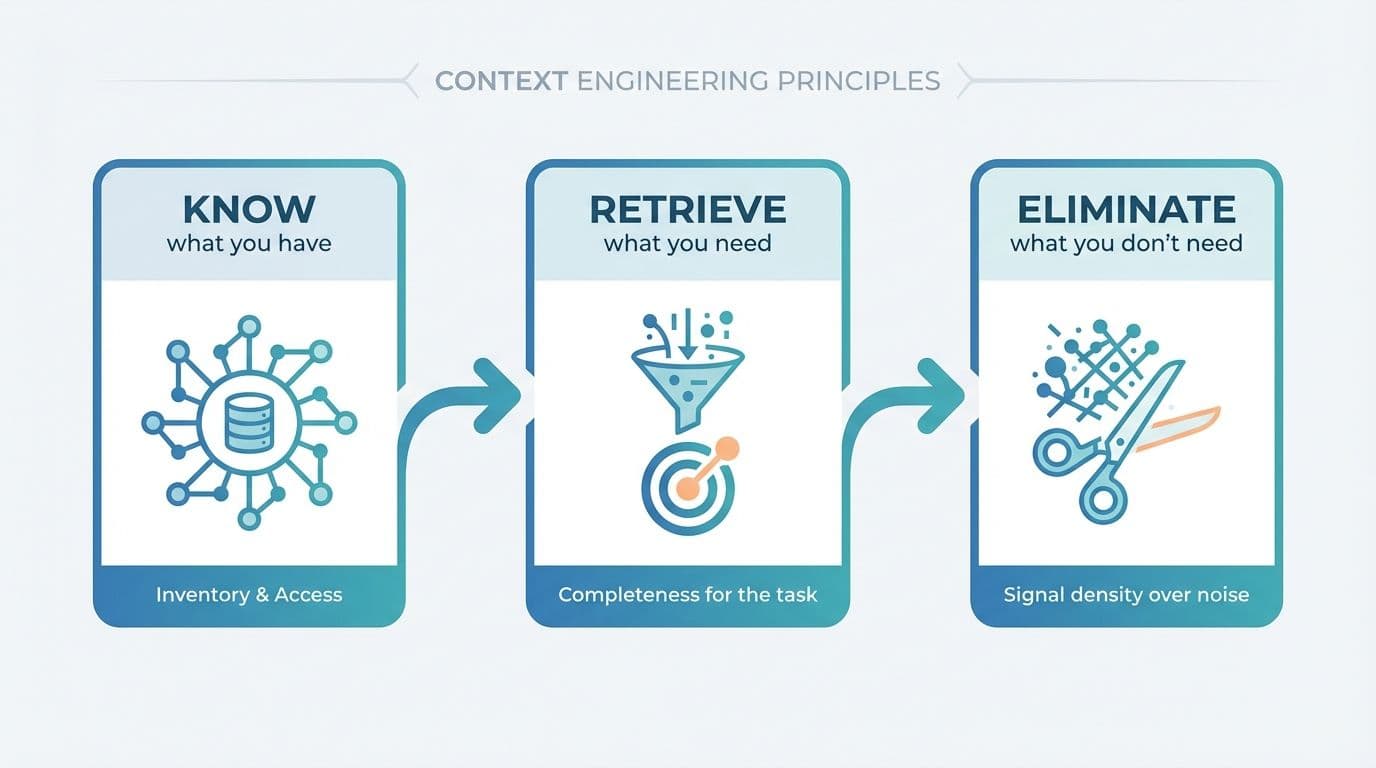
Forget the technical architecture for a moment. At its core, context engineering comes down to three things:
1. Know what you have — and make it retrievable
What data sources exist in your organization? CRM records, emails, call transcripts, Slack threads, documents, calendar events. Most teams have more data than they realize—it's just scattered and inaccessible to their AI systems.
The first job is inventory and access. Map your sources. Build or buy the connectors. Give your agents the tools to retrieve from each source when needed.
This isn't glamorous work, but it's foundational. An AI system can't use data it can't reach.
2. Retrieve what you actually need
For any given query, what information is required to answer it well?
"Prep me for my call with Sarah Chen" needs different context than "Summarize this deal for pipeline review." The first needs stakeholder-specific history—past conversations, documented priorities, open concerns. The second needs a broader view—deal stage, timeline, buying committee coverage, risk factors.
The goal is completeness relative to the task. Not "retrieve everything"—but "retrieve what's necessary for this specific request." This is where query understanding and intent-based routing matter. Different questions require different retrieval strategies.
3. Eliminate what you don't need
This is the one teams underestimate.
More context isn't better. Irrelevant information actively degrades performance—it dilutes the signal, confuses the model, and wastes your token budget. Research on LLM behavior shows that stuffing the context window with marginally relevant content makes outputs worse, not better.
The discipline here is ruthless filtering. If it doesn't directly inform the response, it shouldn't be in the context. This means:
- Relevance thresholds—don't include low-confidence retrieval results
- Recency weighting—older information is often stale noise
- Deduplication—the same fact repeated five ways adds nothing
- Summarization—sometimes a three-sentence summary beats a full transcript
The goal is maximum signal density, not maximum tokens.

From Data Silos to Unified Context
Let's zoom into the most complex layer of the stack: Retrieved Context.
The other layers are relatively straightforward to manage. System instructions are static text you update occasionally. Domain knowledge changes with your product or methodology. Session context accumulates as the conversation progresses. The immediate query is just... the query.
But retrieved context is where the real engineering challenge lives. This is the layer that dynamically pulls relevant information from your data sources—CRM records, email threads, call transcripts, documents—and assembles it in real-time for each query.
And here's the core problem: the intelligence your team needs already exists. It's just trapped.
Stakeholder priorities? Mentioned in call transcripts. Influence dynamics? Evident in email CC patterns and meeting attendance. Objections and concerns? Scattered across Slack threads, CRM notes, and follow-up emails. Engagement trends? Buried in activity logs across six different systems.
A human can synthesize this—given enough time. Before a big call, a diligent rep might spend 30 minutes opening tabs, skimming emails, re-reading notes, and mentally constructing a picture of where things stand. A great manager might do this for every deal in pipeline review, but it doesn't scale.
The retrieval layer automates this synthesis. It's the infrastructure that turns fragmented data into query-ready context.

Let's walk through each stage:
Ingestion and Normalization
Raw data arrives in wildly different formats. CRM data is structured—fields, picklists, timestamps. Email is semi-structured—headers are predictable, but body content is freeform. Call transcripts are unstructured walls of text, often with speaker labels but no inherent organization.
The ingestion layer pulls from each source via APIs, webhooks, or batch syncs. The normalization step transforms everything into a consistent format—standardized timestamps, unified field names, and clean text extraction.
Entity Resolution
This is where raw data becomes connected intelligence.
"sarah.chen@acme.com" in an email thread links to Contact #4521 in your CRM. The @acme.com domain associates emails with the Acme account. Calendar invites tagged with opportunity IDs connect to the right deals.
Entity resolution is the process of linking mentions of people, companies, and deals across all your data sources. Without it, your data stays siloed even if it's technically in one system. With it, you can answer questions like "show me everything related to Sarah Chen" across email, calls, CRM, and chat—instantly.
Storage: Vector Store + Structured Database
Context retrieval requires two types of lookup:
Structured queries answer precise questions: "What's the deal stage? Who's the economic buyer? When was last contact?" This is traditional database territory—SQL queries against normalized CRM data.
Semantic queries answer fuzzier questions: "What are their concerns about implementation?" "Has anyone mentioned our competitor?" This requires vector search—embedding your unstructured content (emails, transcripts, notes) and retrieving based on meaning, not exact keyword matches.
Most production systems use both. Structured data lives in a relational database or your CRM. Unstructured content gets chunked, embedded, and stored in a vector database. The context assembly layer queries both and merges the results.
Context Assembly
This is the orchestration layer—where everything comes together.
Given a query, the assembly layer parses intent, retrieves from the right sources, filters and ranks by relevance, and structures the output for LLM consumption. The output isn't a raw dump of data. It's curated, structured context—organized so the most important information doesn't get lost.
Query Routing and Intelligent Retrieval
Here's where the three priorities come to life in an agentic system.
You have your data infrastructure in place—CRM connected, emails indexed, transcripts embedded, entity resolution mapping mentions to records. The retrieval tools exist.
But tools alone aren't enough. The critical question becomes: which tools, for which query, and how much of the results actually matter?
Not every query needs a vector search across call transcripts. Not every request requires pulling the full stakeholder map. A question about deal stage should hit structured CRM data directly—no semantic search required. A question about unspoken concerns needs transcript retrieval, but doesn't need the company's product documentation.
The intelligence layer handles this through three responsibilities:
1. Intent Recognition
Before retrieving anything, the system needs to understand what type of question it's dealing with.
| Query | Intent | What's needed |
|---|---|---|
| "What stage is the Acme deal?" | Factual lookup | CRM structured data only |
| "What concerns has Sarah raised?" | Stakeholder deep-dive | Transcripts, emails filtered to Sarah |
| "Am I multi-threaded enough on this deal?" | Coverage assessment | Stakeholder map, engagement metrics |
| "Draft a follow-up addressing their security questions" | Content generation | Recent security-related discussion, product docs |
Same deal, completely different retrieval strategies. An orchestrator agent that recognizes intent can route to the right tools—and skip the irrelevant ones entirely.
2. Selective Tool Execution
Once intent is clear, the orchestrator calls only the tools that matter.
Query: "What stage is the Acme deal?"❌ Don't need: Vector search on transcripts❌ Don't need: Email thread retrieval❌ Don't need: Stakeholder sentiment analysis✓ Need: CRM lookup on opportunity record→ Single tool call, instant response, minimal tokens
Compare that to a naive approach that queries everything "just in case"—you'd burn tokens, add latency, and likely surface irrelevant context that confuses the final response.
The orchestrator's job is restraint as much as retrieval.
3. Relevance Evaluation at the Agent Level
Here's the part most teams miss: retrieval agents shouldn't just fetch and return. They should evaluate before returning.
When a retrieval agent pulls candidate results—email chunks, transcript excerpts, CRM records—it asks: Is this actually relevant to the original query?
- "This email mentions Sarah but it's about a different deal—exclude"
- "This transcript excerpt is from 10 months ago, before they restructured—probably stale, exclude"
- "These three emails repeat the same objection—keep the clearest one, drop the rest"
- "This captures her exact concern about integration timelines—definitely include"
The retrieval agent acts as a filter, not a firehose. Only high-signal results flow back to the orchestrator.

The Outcome: Concise Context by Design
When intent drives tool selection, and agents filter before returning, the final context is lean by default.
You're not stuffing the context window and hoping the model figures out what matters. You're curating at every step—selecting the right sources, retrieving the right chunks, and discarding the noise before it ever reaches the final prompt.
This is how you get consistent, high-quality outputs without ballooning token costs or hitting context limits on complex queries.
Conclusion
Context engineering isn't a feature you add. It's a discipline that shapes how your entire AI system works.
The mental model is simple: you're programming what the AI knows at the moment it responds. The context stack gives you a framework—static instructions at the base, dynamic retrieval in the middle, immediate query at the top. Each layer has different update frequencies, different token costs, and different assembly logic.
The priorities are clear: know what data you have and make it retrievable, retrieve what you actually need for the task at hand, and ruthlessly eliminate what you don't. Signal density beats token count every time.
The infrastructure is achievable: ingest and normalize your data sources, resolve entities so everything connects, store in ways that support both structured and semantic retrieval, and assemble context intelligently.
The intelligence layer is where it comes together: agents that recognize intent, route to the right tools, evaluate relevance, and filter before returning. Not a firehose of data—a curated briefing.
For revenue teams, this is how AI becomes a force multiplier rather than a gimmick. The data already exists in your systems. Context engineering is how you unlock it—surfacing the right intelligence, at the right moment, in a form your AI can actually use.
The teams that figure this out won't just have better AI features. They'll have reps who walk into every call fully prepared, managers who spot deal risk before it's too late, and a system that gets smarter as your data grows.
The question isn't whether to invest in context engineering. It's whether you do it now, or watch your competitors do it first.