Your Funnel Isn't Broken, It's Just Out of Date
Michael Maynes
AI Thought Leader
January 8, 2026
5 min read
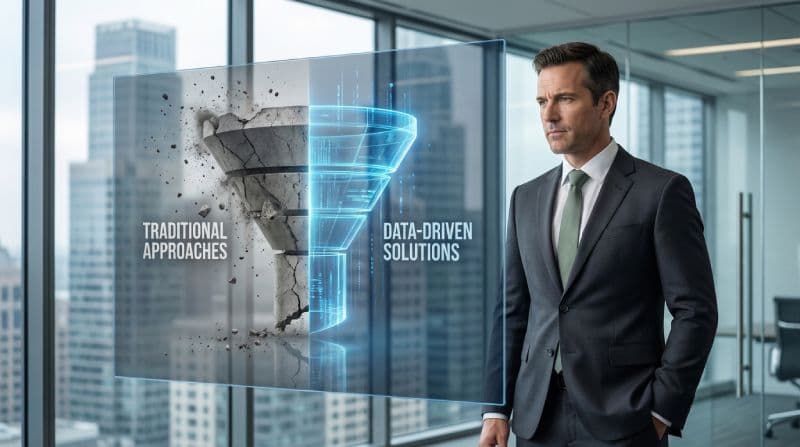
If you've been staring at declining conversion rates and wondering whether your team is underperforming, here's the uncomfortable truth: the funnel assumptions you've been using since 2021 are based on a market that no longer exists.
Your conversion rates didn't drop because your sales team got worse. They dropped because B2B buying fundamentally changed.
The Macro Shift: From "Mistakes Are Free" to "High Consequences"
Between 2022 and 2023, the average B2B company experienced a 24% increase in sales cycle length. Win rates dropped to 17-20%. Pipeline generation fell 47%.
These aren't isolated data points. They're symptoms of two forces that permanently altered buyer behavior.
First: Interest rates went from 0% to 5%. We exited an era where capital was cheap and mistakes were reversible. Financial leaders started putting greater checks on spend. Approval thresholds that once sat with VPs for $50K purchases suddenly required CFO sign-off for anything above $20K.
The average B2B deal now involves 10 stakeholders, up from 5.4 in 2015. That's not complexity for complexity's sake—it's risk mitigation in an environment where every dollar matters.
Second: AI uncertainty created "wait and see" behavior. As generative AI matured through 2023-2025, boardrooms started asking: "Should we invest now, or wait six months to see how AI changes this category?" Buyers weren't saying no—they were saying "not yet."
Why This Hasn't Eased
If you're reading this in 2026, you know the pressure hasn't let up. Tech stocks dropped 30% in 2022. VC funding declined 35%. The capital environment shifted, and buyer behavior transformed with it.
Today, 75% of B2B buyers report taking longer to make decisions than a year ago. Sales cycles have increased 22% over the past few years. These aren't temporary disruptions—they're the new baseline.
What This Means for Your Forecast
Here's what most CEOs miss: if your funnel conversion assumptions are based on pre-2022 data, your forecast is structurally wrong.
You're likely:
- Under-forecasting time to close deals
- Over-estimating stage conversion rates
- Mis-sizing your sales team based on outdated productivity assumptions
This isn't a minor calibration issue. It's the difference between a predictable revenue engine and a constant state of "why did we miss again?"
The companies forecasting accurately right now aren't using better CRMs. They updated their assumptions to match the market they're actually selling into.
The Bottom Line
Your declining funnel conversion isn't evidence of poor execution. It's evidence that macro forces—rising interest rates, tightened financial controls, AI uncertainty—fundamentally altered how businesses buy.
CEOs who recognize this and recalibrate will forecast more accurately and stop the cycle of missed quarters and difficult board conversations. Those who keep pushing pre-2022 assumptions will continue to be frustrated by results that don't match effort.
Your funnel isn't broken. It's just calibrated for a world that no longer exists.
What does this look like at the deal level? Your VP Sales is navigating these forces every day—longer cycles, more stakeholders, slipping forecasts. If you want to understand how this plays out in the pipeline and what tactical adjustments actually work, read: Why Your Best Reps Can't Hit the Same Numbers They Did in 2021
About 1337 Sales
1337 Sales builds low-code and agentic solutions for businesses modernizing their revenue operations. We help companies navigate the shift from static tools to intelligent systems that adapt to market changes.